

A product with 92,000 Amazon reviews and a 4.4-star average is practically a standing ovation from the internet. When I first started recommending Amazon Basics Vacuum Storage Bags to clients, I was not doing it because of the ratings. I was doing it because I had watched a single pack transform a bedroom closet that had been a running argument between two spouses for four years. But after fielding calls from clients who bought the bags, used them incorrectly, and declared them useless, I started looking harder at what those 92,000 reviews are actually saying and, more importantly, what they are leaving out.
This review is not a repeat of the five-star highlights. You can read those yourself. This is the part the ratings do not cover: the size traps that cause disappointment, the items that should never go inside a vacuum bag, the valve mechanics that most buyers skip over in the instructions, and the specific scenarios where a cheaper product does the job and a more expensive one does not change your outcome. If you have already done some searching and know vacuum bags exist but want to know whether this particular set will actually solve your problem, this is where to start.
The Quick Verdict
A legitimate organizer's tool at a price that removes the hesitation, but only if you match the size to the item and know upfront which items belong in a compression bag and which do not.
Amazon Check Today's Price →92,000 buyers found something that worked. Here is how to make sure you are one of them.
The Amazon Basics Vacuum Storage Bags are available in multi-size packs covering small through jumbo. The difference between a buyer who raves and a buyer who returns often comes down to one purchase decision: matching size to item. Check the current listing for the available pack configurations and read the size guide before you add to cart.
Amazon Check Today's Price on Amazon →What the Five-Star Wave Is Actually Measuring
A rating above 4.0 on a product with more than 50,000 reviews means one thing clearly: most people who bought it got what they expected. For vacuum bags, that expectation is simple. You put a bulky item in, you attach the vacuum, the bag shrinks, you gain shelf space. When that transaction happens cleanly, buyers rate it five stars. And it does happen cleanly. I have used these bags in a wide range of client homes and the basic compression mechanism works consistently when the bag is sealed correctly.
What the five-star total does not reflect is the segment of buyers who purchased the wrong size, filled the bag with the wrong type of item, or expected a level of air-tight permanence that no vacuum bag at this price delivers. Those buyers either leave a one-star review or, more often, simply return the product and move on. The 4.4 average is telling you the product does what it says. It is not telling you it is right for every closet problem. My job here is to help you sort those two things out before you order.
The Size Chart Nobody Reads Until After They Have the Wrong Bag
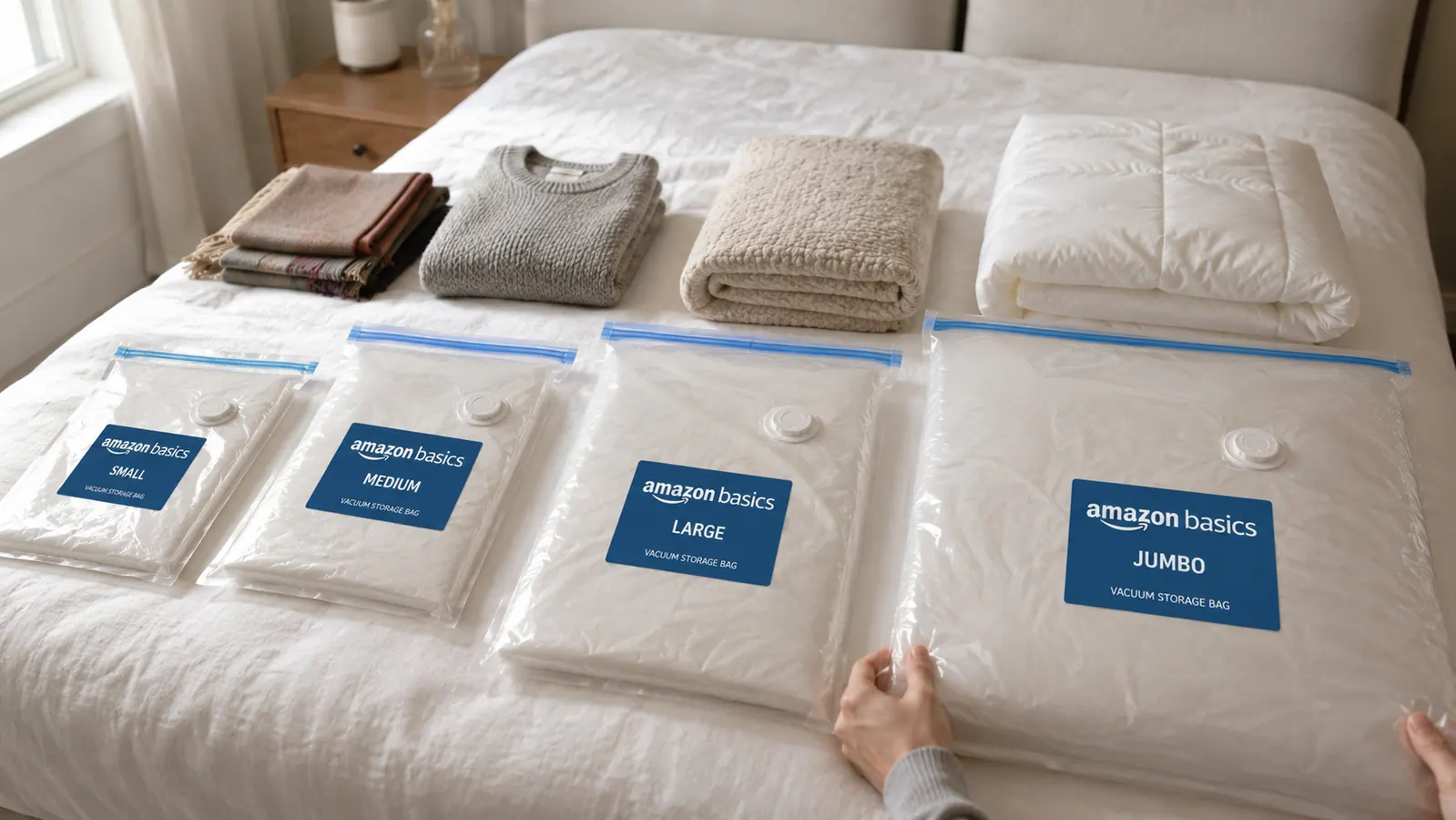
This is where most disappointed buyers go wrong. The Amazon Basics set comes in four sizes: small, medium, large, and jumbo. The names sound intuitive, but the actual dimensions are worth reading carefully before you decide which pack to order. A jumbo bag is roughly 39 by 27 inches. That is sized for a king or queen comforter, a sleeping bag, or a bulky ski jacket. A large bag runs approximately 27 by 19 inches. That is the right size for a throw blanket, two adult winter coats folded together, or a stack of four to five heavy sweaters.
Medium bags, about 24 by 16 inches, are where I put folded layering pieces, kids' outgrown clothing being held for a sibling, and seasonal accessories like scarves and hats. Small bags, roughly 20 by 15 inches, are tight even for a thick scarf collection. I use them primarily for travel compression or for storing a single item temporarily, not as a main seasonal tool. The failure mode I see most often: a client orders one pack of large bags, tries to put a king comforter inside, cannot get the zip to seat because the bag is too small for the volume, and concludes the bags do not work. The bag works. The size was wrong.
My standard advice: look at your largest item first. If it is a king or queen comforter, you need jumbo. If it is a folded throw or a standard-size jacket, large is your baseline. Order a pack that covers your biggest item, then work down from there. Buying a jumbo-plus-large combo pack and one additional medium pack tends to cover a full bedroom closet rotation for most households.
The Valve Mechanics: What the Instructions Assume You Already Know
Every vacuum bag has two sealing systems working together: the zip closure and the one-way valve. The zip is what keeps air out when you are not compressing. The valve is what lets air exit when you attach the vacuum. Both have to work for the bag to hold compression. Most buyers understand the valve intuitively because it is the dramatic part. You attach the hose, the bag deflates, the process feels conclusive. What buyers often miss is that the zip seal is where air re-enters after storage, and getting it right takes one extra step most people skip.
The double-zip on the Amazon Basics bags has two parallel tracks. You need to run your fingers along both of them until you feel the full length of each track click into place. This is not a single swipe from left to right. It is a slow two-finger press along the entire width of the bag, repeated twice, checking that the center section is as sealed as the edges. The center is where the zip most commonly fails to seat on the first pass, and a one-centimeter gap in the center of a zip will let air back in within a week of storage. I have watched this exact failure happen with clients who called to say their bags deflated and could not understand why. Every single time I walked them back through setup, the zip had not been fully seated.
Once you know this, it is a thirty-second habit. Once you do not know it, it is a source of reliable frustration. The instructions do mention the double-zip, but the language is brief. Treat the zip as the most important step, not a formality, and the valve will do its job correctly every time you compress.
Every client who called to say the bags stopped working had one thing in common: the double-zip had not been fully seated. Fix that one habit and the bag performs exactly as advertised.
What You Should Never Put in a Vacuum Bag (The List the Product Page Skips)
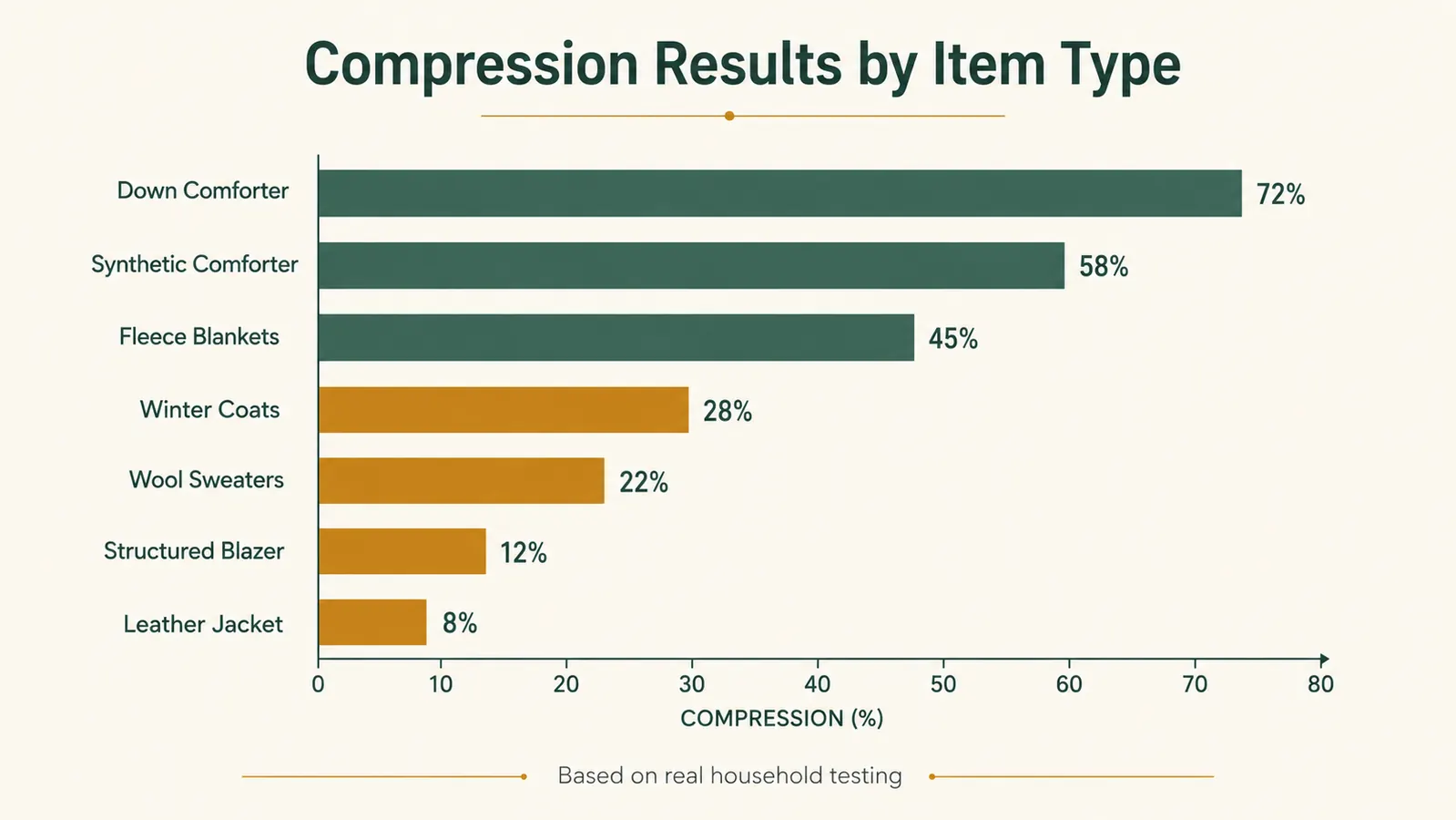
Vacuum bags are a compression tool, and compression is not appropriate for everything in a closet. This is the part of the review that the star rating cannot communicate. Leather garments, including leather coats, leather-trimmed jackets, and anything with leather patches or detailing, should not go into a vacuum bag. Compression over months causes leather to crack and crease in ways that are difficult or impossible to reverse. I have seen a client's expensive leather bomber jacket come out of a vacuum bag in May with a series of permanent horizontal creases across the front because the compression had folded it in the same position for six months.
Structured garments are similarly problematic. A blazer with padded shoulders will lose its shape under extended compression. The padding does not spring back the way synthetic fill does. Formal wear, structured coats with boning or interfacing, and anything with a shape that is designed to be maintained should go into a breathable garment bag instead of a vacuum bag. Down comforters deserve a separate note: short-term compression for a move or a guest room swap is generally fine. But storing a high-quality down comforter in a vacuum bag for the full four to six months of a seasonal rotation can damage the down clusters and reduce loft when it comes back out. If the comforter is a significant investment, use a cotton storage bag. If it is a standard polyester fill, vacuum compression is fine.
The items that work best in vacuum bags are those with air trapped in the fill: synthetic comforters, fleece blankets, throw blankets, knit sweaters, base layers, ski and snowboard gear, and bulky casual outerwear without structured elements. If the item is lofty and washable, it is almost certainly a good vacuum bag candidate. If it has structure, shape, or delicate material, store it differently.
What I Liked
- Genuine compression on lofty items like synthetic comforters, fleece, and knit sweaters
- Four-size range covers items from a single scarf to a king-size comforter in one product line
- Low per-bag price means buying enough for a full closet rotation does not require a budgeting decision
- Standard one-way valve works with any household vacuum, no pump required
- Stacks flat after compression, fitting neatly on shelves or inside storage bins
- 92,000-plus buyer track record means any issue you encounter has a documented solution in the reviews
- Bags are reusable across multiple seasonal cycles when the zip track is cared for properly
Where It Falls Short
- Size names are intuitive but actual dimensions require checking before ordering to avoid a mismatch
- Double-zip setup requires a deliberate two-pass technique that is easy to skip and causes most buyer complaints
- Not appropriate for leather, structured garments, or high-quality down that needs loft preservation
- Plastic is thinner than premium brands, which matters if bags will be handled frequently or stored in rougher conditions
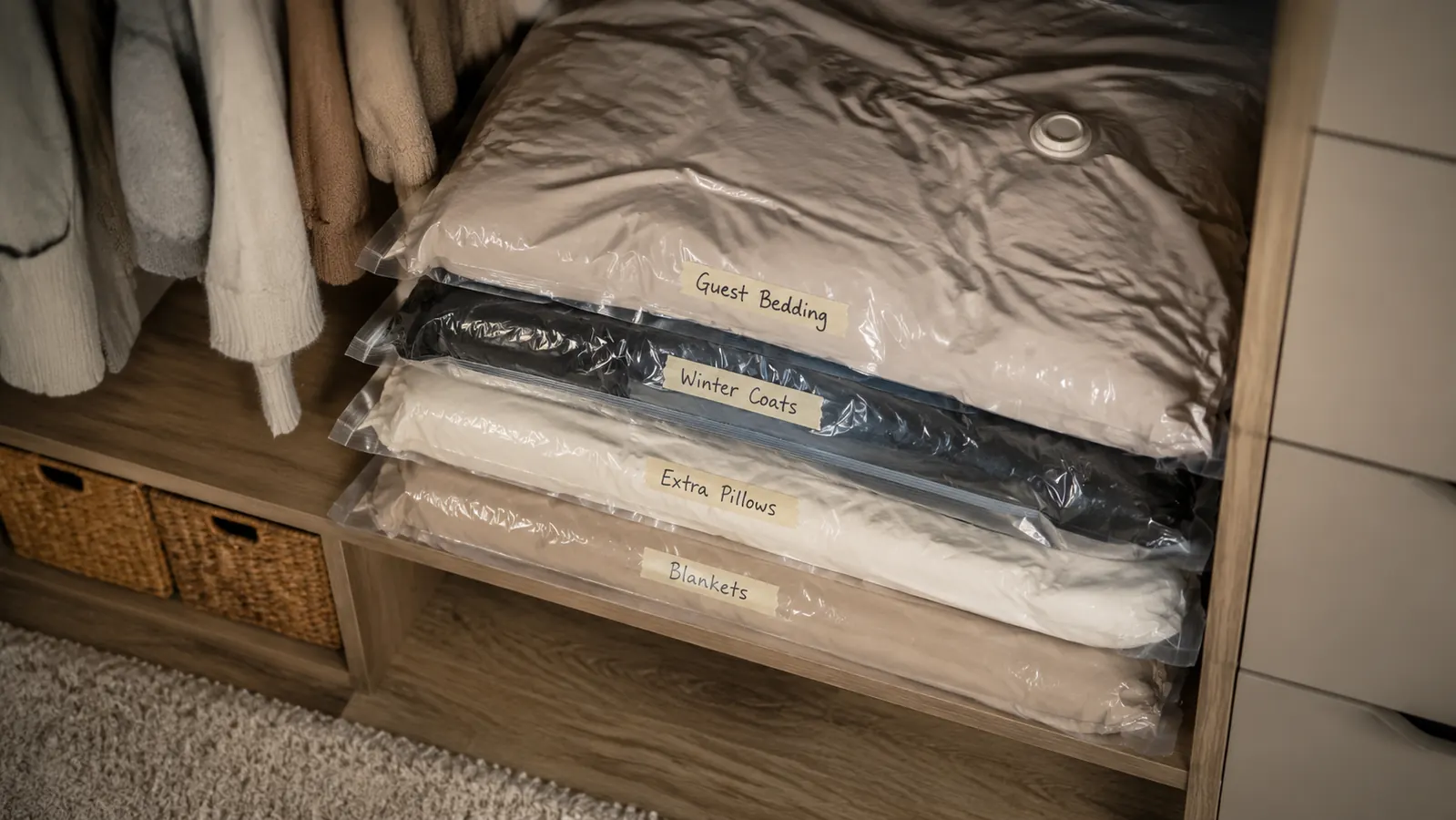
- No pre-printed content labels on the bags, so identifying contents during storage requires your own labeling
- Compression ratio on dense items like wool blankets or tightly woven bedding is noticeably lower than on lofty fills

The Amazon Basics Brand Question: Does It Matter Here?
Clients sometimes ask whether they should pay more for a specialty organizer brand's vacuum bags instead of the Amazon Basics version. It is a fair question. The Amazon Basics brand covers a wide range of product quality, from excellent to mediocre depending on the category. For vacuum storage bags specifically, the performance gap between the Amazon Basics version and a bag that costs twice as much comes down to one thing: plastic thickness. Premium bags use heavier gauge plastic that is more resistant to puncture during repeated handling and less likely to develop microtears after several seasons of use.
In practice, for a household that compresses items twice a year and stores the bags on a shelf without significant handling, the thinner plastic on the Amazon Basics bags has not caused meaningful failures in my experience. The seal holds. The bags do not puncture under normal storage conditions. Where the thicker plastic matters is in households with rougher storage environments: garages with temperature swings, bins that get dragged across concrete, or frequent mid-season access where the bags are handled repeatedly. If that describes your situation, spending a few dollars more per bag on a heavier gauge product is worth it. For a standard linen closet or bedroom closet with twice-yearly access, the Amazon Basics bags are a practical choice.
Who This Is For
These bags are the right fit for anyone whose closet is genuinely full because of bulk, not because of too many items. The distinction matters. If you are running out of closet space because you own too many things, vacuum bags will compress what you have but will not create a system that stays organized on its own. If you are running out of closet space because your off-season comforters and winter coats are eating half the available shelf space, vacuum bags solve that problem directly and immediately. Renters who cannot modify their storage, households without attic or basement storage, families managing seasonal clothing across multiple children, and anyone rotating guest room bedding are the buyers who get the most straightforward benefit from this product. The 92,000 reviews are not a coincidence. The product works, within the boundaries described here, reliably and consistently.
Who Should Skip It
If your closet holds primarily structured clothing, formal wear, leather goods, or high-end natural-fill bedding, vacuum bags are not your solution. The same applies if your storage environment involves frequent temperature extremes or physical handling of the bags, since the standard-gauge plastic is not built for that. And if you are hoping compression bags will solve a clutter problem rather than a bulk problem, they will not. I have seen clients fill bags with items they have not touched in three years. The bags compressed the items efficiently. But a year later, the closet was full again because the underlying habit of accumulating without editing had not changed. Vacuum bags are a space tool. They work best alongside a periodic review of what actually belongs in the closet in the first place.
Know what goes in, know the sizes, and these bags do exactly what 92,000 buyers said they do.
The Amazon Basics Vacuum Storage Bags are available in multiple pack configurations. For a standard bedroom closet rotation, I recommend starting with a pack that includes at least two jumbo and two large bags, then adding a medium pack for clothing and accessories. Check the current listing to see which configurations are available and whether a multi-size bundle is in stock.
Amazon Check Today's Price on Amazon →