
Most laundry piles do not start in the laundry room. They start on the bedroom chair, the bathroom floor, the corner of a closet. By wash day, you are hunting down strays from three rooms, then sorting everything at the machine while a full load waits. I spent years running that routine before I realized the sorting step was the problem, not the washing. Once I moved sorting to the point of undress instead of the point of washing, laundry stopped feeling like a project and started feeling like a chore I had already mostly done.
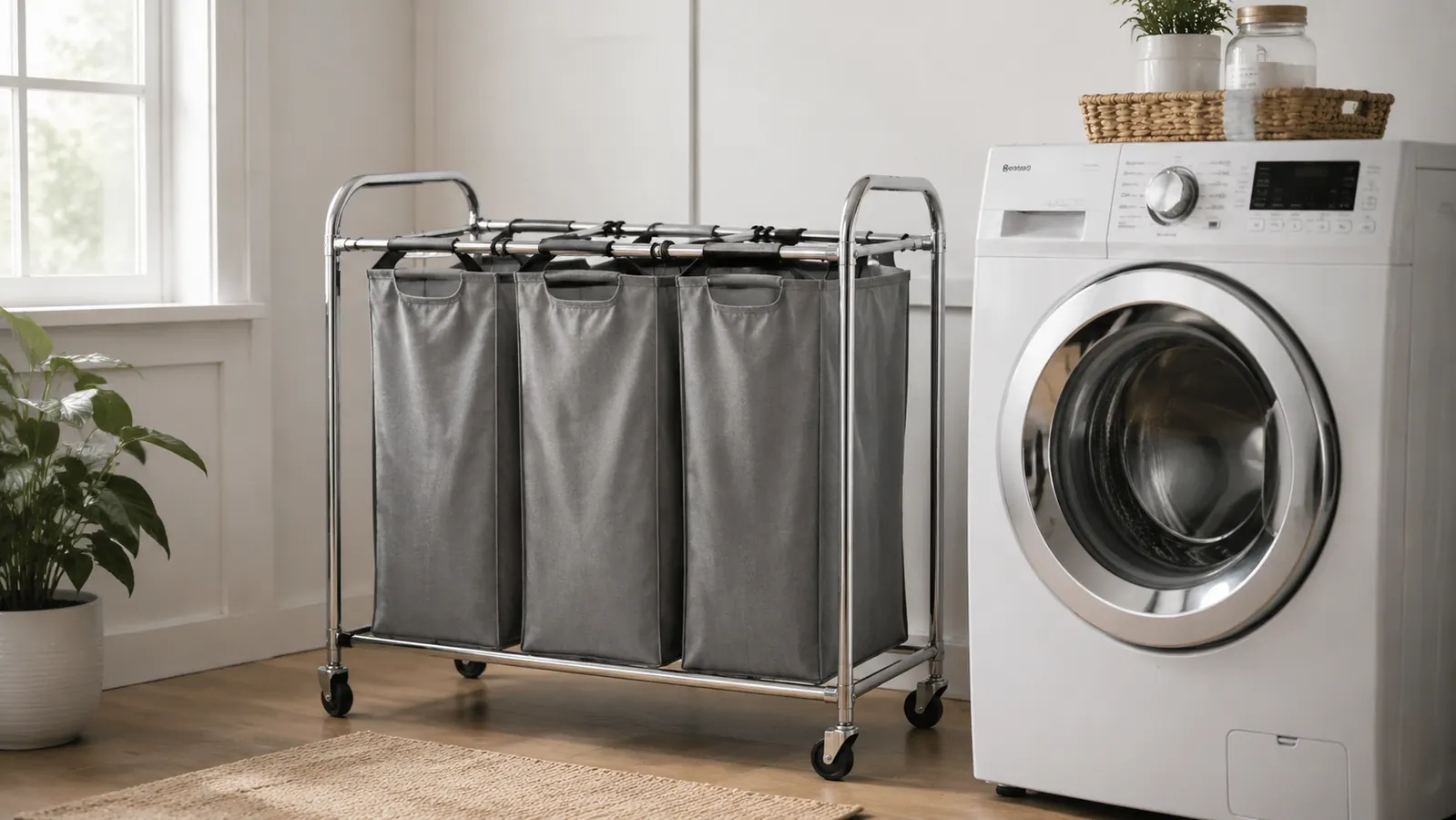
The tool that made this possible is a 3-bag rolling laundry sorter. Specifically, the Simple Houseware Heavy Duty 3-Bag Rolling Cart. I set it up in the master bedroom hallway for a family of four, and inside two weeks the whole household was using it without being asked. This guide walks through exactly how I set up that system, how I labeled it, where I placed it, and how we run the actual wash cycle once a bag fills up. No sorting on wash day. No laundry piles. Just a cart that does the thinking for you.
Skip the wash-day sorting scramble entirely
The Simple Houseware 3-Bag Rolling Cart pre-sorts your laundry all week long. Pull a bag, load the machine, done. Over 25,000 buyers have made the switch.
Amazon Check Today's Price on Amazon →Why Most Laundry Routines Break Down at the Sorting Step
The one-hamper system is the default for most households, and it creates a guaranteed bottleneck. Everything goes in together, which means before you can run a single load you have to pull everything back out and sort by color, fabric weight, or care instruction. Do that for a family of four after a full week of clothes and you are looking at a fifteen-minute sorting session before the first load even starts. That is fifteen minutes standing in front of a pile making low-stakes decisions over and over.
The other common workaround is multiple individual hampers in separate rooms, one for darks, one for lights, something for towels. That spreads the problem across the house without solving it. You still have to consolidate at wash day, and the hampers are usually full bins you cannot roll anywhere. A 3-bag rolling cart solves both problems because every item goes into its correct bag at the moment it comes off, and on wash day you simply unzip a bag and carry it to the machine. The sorting work is already done.
Step 1: Choose the Right Spot for the Cart
Placement is the single factor that determines whether this system sticks or gets ignored. The cart needs to be within arm's reach of where clothes actually come off. For most households that is the master bedroom, the master bathroom doorway, or the hallway between bedrooms. Putting it in the laundry room only works if everyone walks to the laundry room to undress, and almost nobody does that.
I keep mine in the hallway just outside the master bath. When my husband or I undress at night, the cart is three steps away. For kids' rooms, I added a second smaller hamper that gets emptied into the cart twice a week. You do not need the cart to catch every garment in real time. You need it close enough that sorting feels like less work than dropping things on the floor.
The Simple Houseware cart rolls on four casters, two of which lock, so it stays put in a hallway without wandering. The footprint is roughly 23 inches wide by 13 inches deep, which fits in most hallways without blocking foot traffic. Measure your spot before you order, but in most standard homes this cart tucks in neatly.
Step 2: Label All Three Bags Before You Load a Single Item
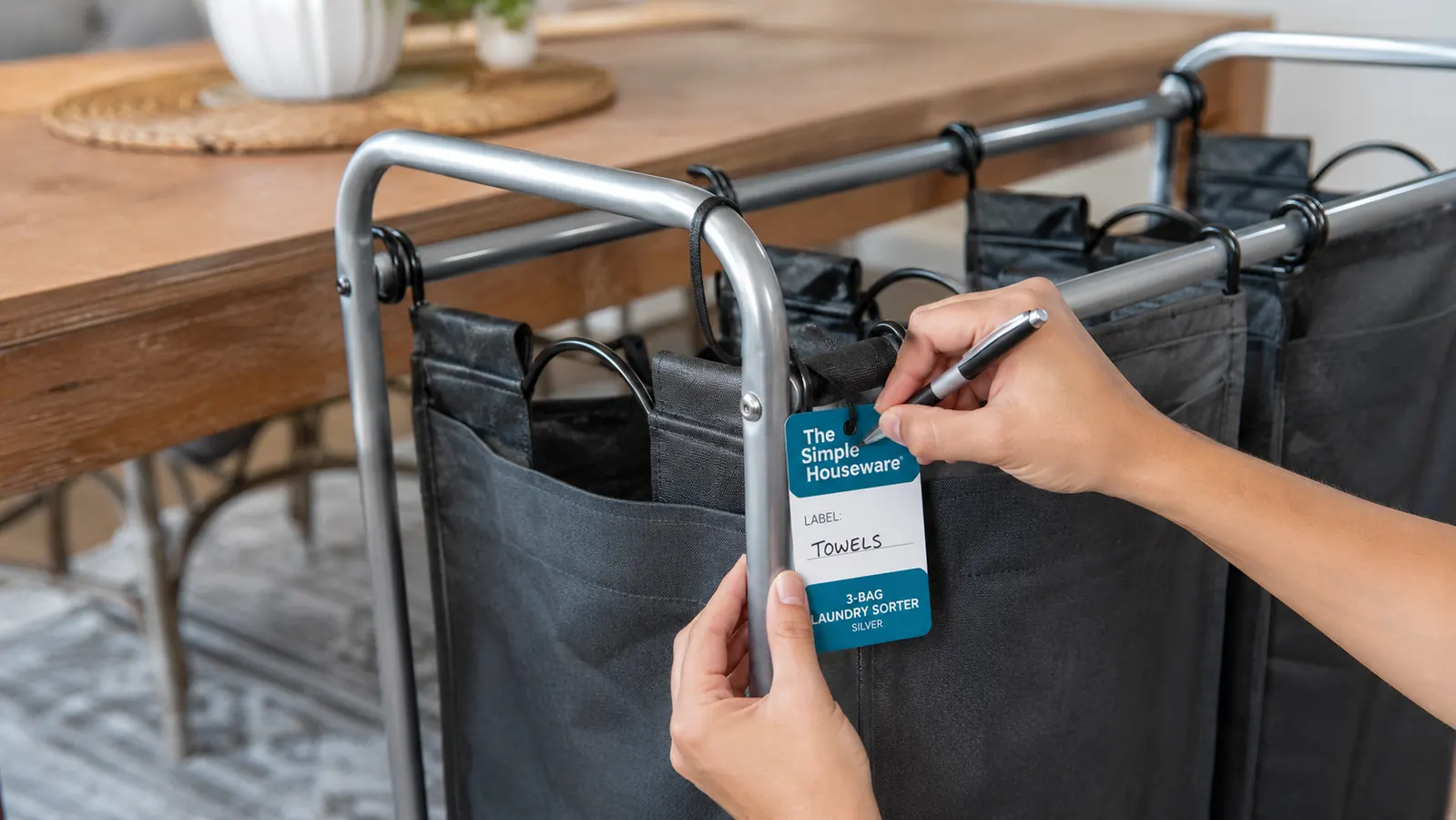
The most common reason multi-bag systems fail is unclear labeling. When bags are not labeled, each person in the household makes their own sorting decision, and they are often different. Whites end up in lights, delicates end up with darks, and after two weeks you are back to sorting at the machine.
Write your categories clearly and attach the label to the bag, not the frame. The bags on the Simple Houseware cart unzip and lift out, so a label on the frame becomes meaningless once a bag is removed. I use a strip of white cloth tape and a permanent marker, written large enough to read without squinting. My three categories are Darks and Brights (left bag), Lights and Whites (middle bag), and Delicates and Hand Wash (right bag). Your household may use different splits. What matters is that the categories are specific, visible, and agreed upon by everyone who uses the cart.
If you have young kids, consider color-coding instead of or in addition to words. A strip of dark fabric taped to the left bag, a white strip on the middle, and a pastel strip on the right works for children who cannot read yet and also for adults making tired late-night decisions.
Step 3: Set a Fill-Level Rule, Not a Day-of-Week Rule
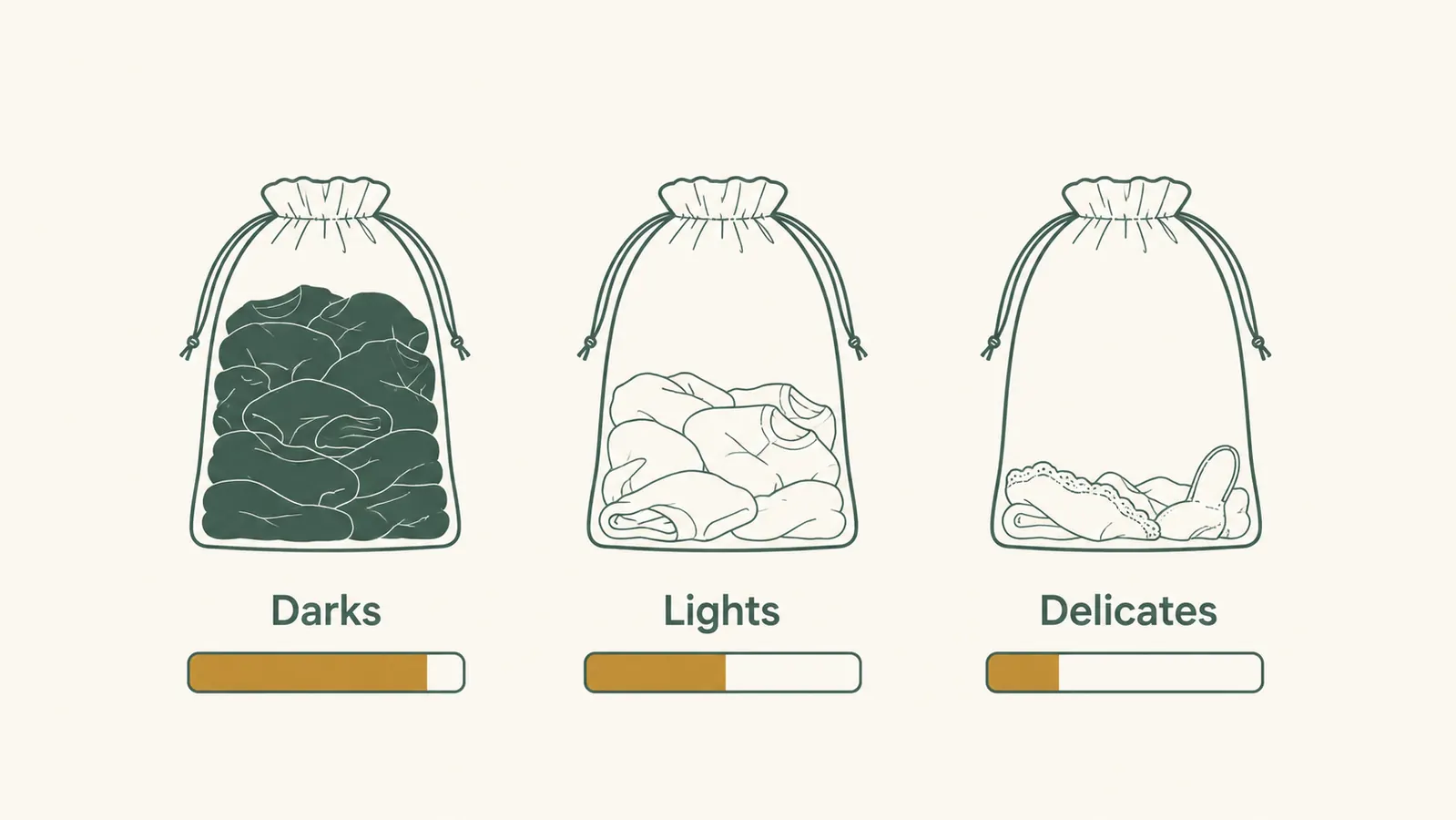
Washing by day of week is the other habit that creates unnecessary pressure. If you commit to laundry every Saturday, you end up either washing half-full bags because the day arrived, or overstuffed bags because you missed a week. Both outcomes waste time and often waste water. A fill-level rule is more efficient and more flexible.
My rule is simple: the moment a bag reaches the top zipper it goes in the wash that same day, not the next laundry day. For a family of four, darks and brights hit that level twice a week. Lights and whites run once a week. Delicates run every two weeks or so. The cart tells me when to wash by filling up, not by the calendar. This means I never run a half-load, and I never face a mountain of backlogged laundry on a Saturday morning.
The cart tells me when to wash by filling up, not by the calendar. Laundry day became three separate ten-minute jobs spread across the week instead of one two-hour project on a weekend.
Step 4: Roll the Cart to the Machine, Not the Other Way Around
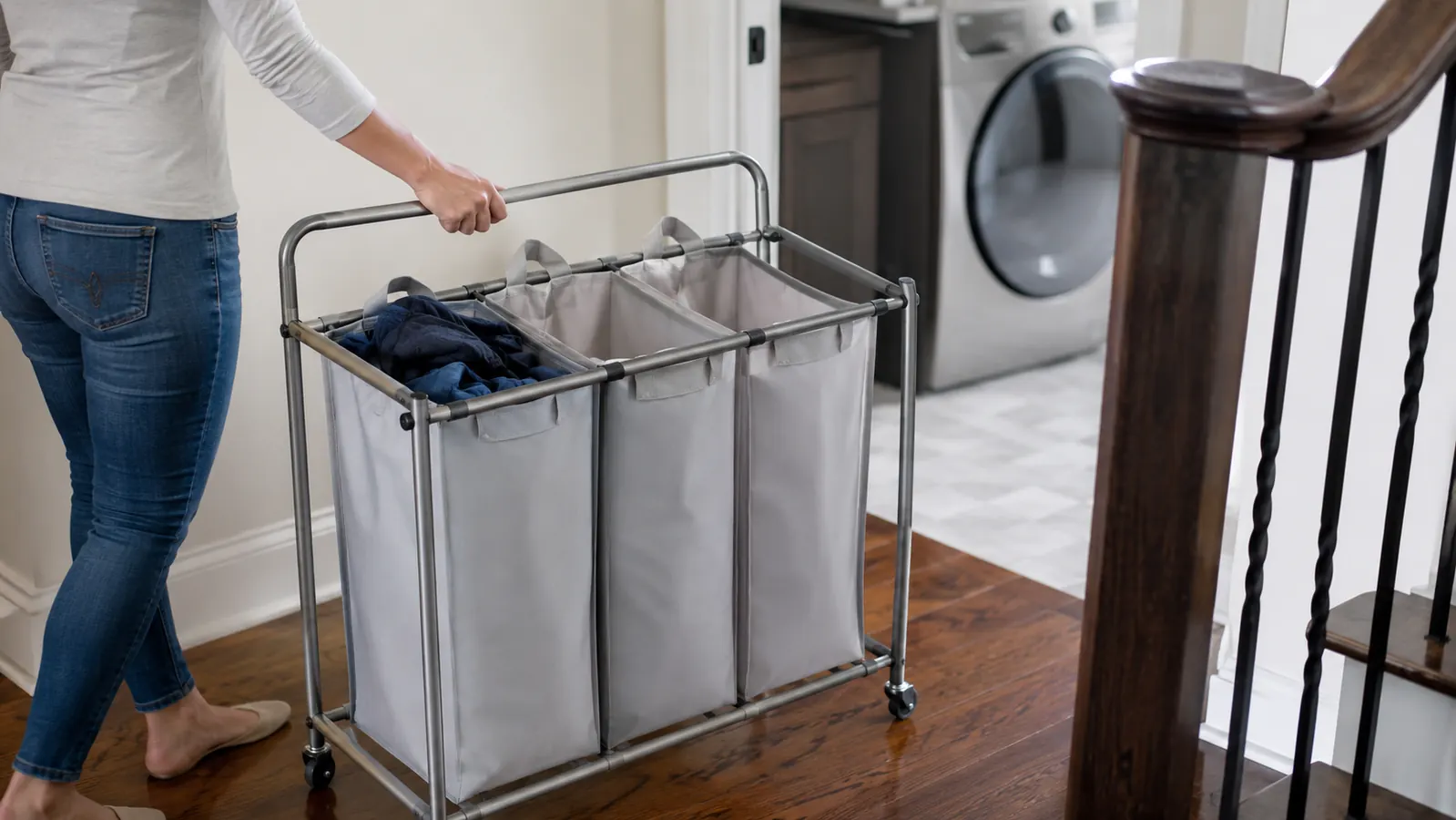
This is the step that makes the whole system feel almost effortless. Instead of carrying an armload of unsorted laundry to the machine, you unzip the full bag from the cart, carry it to the washer, and pour the contents directly in. The bag is lightweight enough to carry with one hand when full and zippered, so nothing falls out in transit.
Alternatively, if your laundry room is close enough, you can roll the whole cart to the machine and transfer the bag there. The Simple Houseware cart rolls smoothly on hard floors and will go over low thresholds without tipping. On carpet the rolling is slightly heavier but still manageable with one hand when the other bag slots are not full. I use the roll-and-transfer approach when I am doing a full laundry day and washing multiple loads back to back.
Rehang the empty bag on the frame immediately after you start the wash. Do not leave it on the floor or on top of the washer. The system only works if the cart is always ready to receive new items. An empty bag back on the frame takes about fifteen seconds and keeps the routine from breaking down between loads.
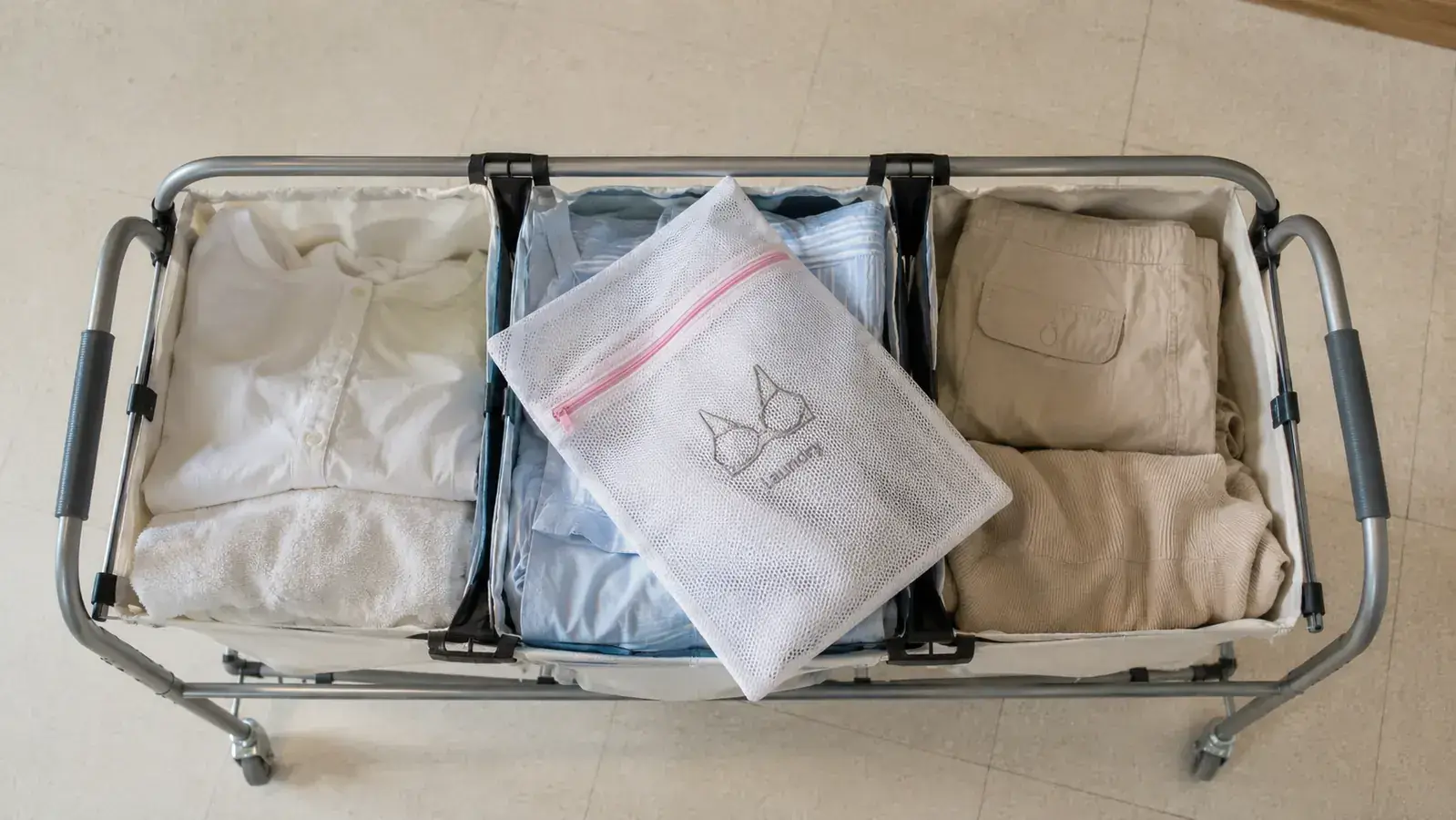
Step 5: Add a Small Mesh Bag to the Frame for Socks and Delicates
The one limitation of any open-bag sorter is small items. Socks, underwear, and delicates sometimes migrate between bags or get lost at the bottom of a large load. My fix is a small hanging mesh laundry bag clipped to the cart frame with a carabiner. Any delicate item or sock pair goes directly into the mesh bag. On wash day the mesh bag goes into the machine closed, so delicates never touch the drum directly and socks stay paired.
This addition costs about four dollars and takes thirty seconds to set up. It also solves the single-sock problem almost completely, because socks are always contained instead of scattered across three bags or piled on the cart frame. If you have teenagers or kids who generate large volumes of socks, a mesh bag per person hung on the frame works even better.
What Else Helps: Pairing the Cart with Two Other Habits
A good sorter cart is a system, not just a piece of furniture. Two habits amplify what the cart does and prevent the most common ways organized laundry routines fall apart. The first is a consistent spot for items that need pretreating. I keep a small spray bottle of stain remover on the shelf directly above the cart. When something goes into the bags with a stain, I spray it before it hits the bag, not after it has been sitting in a dark bag for five days. Stains that have been treated promptly come out in a normal wash cycle. Stains that have been ignored for a week often require a second wash or never fully come out.
The second habit is a folding cadence that mirrors the filling cadence. When a load comes out of the dryer, it gets folded that same day, not left in the dryer or piled in a laundry basket to wrinkle. I know that is the habit most people struggle with, including me for years. What changed it for me was shrinking the pile. When you are washing by fill level instead of once a week, a completed load is one bag's worth of clothes, not seven people-days of laundry all at once. A smaller pile is less intimidating, and the time from folding to being done is short enough that it does not feel like a weekend project.
Who This Routine Works Best For
This system fits households where at least two people are responsible for their own laundry and where the main problem is the sorting step taking too long or getting skipped. It works especially well for families with kids old enough to understand a two-category or three-category sort, typically around age six and up. It also works well for couples who share a laundry space but have different care needs for their clothes, because each bag can represent a wash type rather than a person.
If you live alone and run laundry once a week regardless of volume, a single-bag hamper may suit you just as well and take up less floor space. The 3-bag rolling cart earns its footprint when sorting is a daily friction point for more than one person, when the household generates enough volume to run multiple load types per week, or when the person doing laundry wants to delegate the sorting decision to the rest of the household rather than making it themselves every time.
Who Should Skip the Rolling Cart Approach
A rolling sorter cart is not the right fit for every space. If your laundry room is in the basement and your bedrooms are on the second floor with a narrow staircase, rolling the cart to the machine is not practical. In that case, the bags-only approach works: keep the cart near the bedroom, unzip bags when full, and carry bags down the stairs. The Simple Houseware bags zip closed and are durable enough to carry filled without tearing. The frame stays upstairs as the organizing structure and the bags do the transport work.
Very small apartments with no hallway space or laundry in a shared building may also find the 23-inch footprint too large for the bedroom. In those spaces, a two-bag wall-mount sorter or a flat-fold hamper with a divider may serve better. The underlying sorting-at-undress habit is what creates the time savings. The specific cart is the most convenient tool for most homes, but the principle works with any multi-compartment container you can keep where clothes actually come off.
Your laundry routine is already almost done for the week
Set up the Simple Houseware 3-Bag Rolling Cart once using this guide and the sorting work is finished before wash day even starts. Check the current price and availability on Amazon.
Amazon Check Today's Price on Amazon →